
Editorial status: Evidence reviewed 27 July 2026. Not medically reviewed.
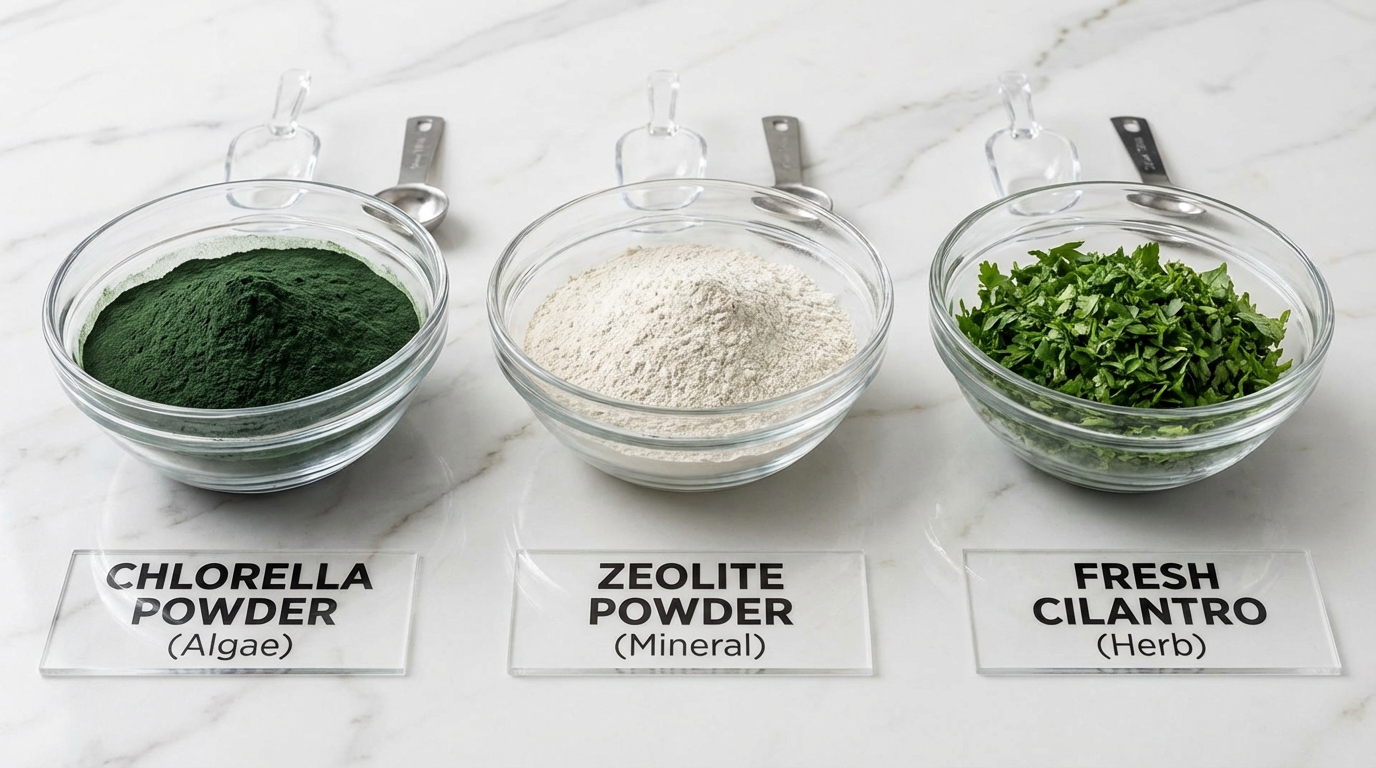
If you search for ways to “detox” heavy metals, three names appear repeatedly: zeolite, chlorella, and cilantro. The marketing is confident. The clinical evidence is not.
None of these products should be treated as a do-it-yourself substitute for identifying an exposure, obtaining the correct test, removing the exposure source, and receiving medical treatment when it is indicated. Heavy-metal toxicity is not one condition: lead, mercury, arsenic, and cadmium differ in their sources, tests, health effects, and treatment.
This comparison explains what researchers have actually studied—and where product claims run ahead of the data.
The short answer: Zeolite has one recent, small randomized trial as an addition to standard treatment for mild-to-moderate lead poisoning. Chlorella has limited and methodologically weak human evidence involving a combination supplement. Cilantro does not have convincing controlled human evidence as a heavy-metal treatment. That is not enough to recommend any of the three for routine “detox.”
First: exposure is not the same as poisoning
Metals occur naturally in the environment, and small detectable amounts do not automatically prove toxicity. The health significance depends on the specific metal, chemical form, dose, route, timing, and the person exposed.
Useful next steps begin with the suspected source:
- Lead: old paint or dust, contaminated soil or water, some occupations or hobbies, imported products, and certain traditional remedies.
- Mercury: some workplace exposures, spills involving elemental mercury, and high intake of certain fish. Dental amalgam is a different exposure question from acute mercury poisoning.
- Arsenic: contaminated well water, some occupational settings, and certain foods. Seafood can temporarily raise total urine arsenic because it contains less harmful organic forms.
- Cadmium: tobacco smoke, some workplace exposures, and contaminated food or soil.
The Agency for Toxic Substances and Disease Registry publishes metal-specific clinical guidance because there is no single universal “heavy-metal detox.”
Testing should match the metal and exposure window
An online symptom list cannot diagnose metal poisoning. Fatigue, headache, poor concentration, nausea, and abdominal symptoms have many possible causes.
Testing also is not interchangeable:
- For suspected recent or ongoing lead exposure, ATSDR states that a blood lead level should be performed.
- For recent arsenic exposure, a 24-hour speciated urine arsenic test can help distinguish toxic inorganic arsenic from organic arsenic associated with seafood.
- Hair testing has major limitations because external contamination can be difficult to distinguish from metal incorporated inside the hair.
- “Provoked” urine testing—collecting urine after a chelating drug—is not recommended as a diagnostic test. It can produce misleading results and an apparent diagnosis that does not correlate with conventional testing.
The right test should be selected and interpreted by a clinician familiar with environmental or occupational exposure. If a significant exposure is possible, reducing or removing the source is usually more important than buying a supplement.
Zeolite: promising early evidence is not established treatment
Zeolites are porous aluminosilicate minerals. Clinoptilolite, one form sold as a supplement, can exchange ions and adsorb substances under certain conditions. That physical property helps explain the hypothesis that it might bind some metals in the digestive tract. A plausible mechanism, however, is not proof of a meaningful clinical benefit.
What human research exists?
A 2025 double-blind randomized clinical trial included 80 adults with mild-to-moderate lead poisoning. Participants received either standard treatment alone or zeolite tablets in addition to standard treatment. After two weeks, the zeolite group had a lower average serum lead level.
That result is worth further study, but it does not establish zeolite as a general-purpose detox supplement:
- It studied people with diagnosed lead poisoning, not healthy people seeking preventive detoxification.
- Zeolite was used with standard treatment, not as a replacement.
- The study was short and involved a single center and a small population.
- The result concerns lead; it cannot be automatically extended to mercury, arsenic, or cadmium.
- It does not establish an over-the-counter product, dose, purity standard, or long-term safety plan for self-treatment.
The FDA has also issued a warning letter involving zeolite detox claims, illustrating the gap that can exist between supplement marketing and approved medical claims.
Practical conclusion on zeolite
The fair conclusion is “preliminary human evidence in a specific clinical setting,” not “proven detox.” People with suspected lead poisoning should seek appropriate testing and treatment rather than using retail zeolite on their own.
Chlorella: limited evidence, with important confounding
Chlorella is a freshwater green alga sold as a food supplement. Laboratory and animal studies suggest that components of chlorella can interact with some metals. Those studies can generate hypotheses, but they do not demonstrate that taking chlorella treats metal toxicity in people.
What human research exists?
A 2019 study followed 16 people with long-term dental implants and amalgam fillings who received a combination of chlorella, Fucus extract, and other nutraceutical ingredients for 90 days. Researchers reported changes in several metals measured in hair.
The study cannot tell us that chlorella alone caused the changes:
- It used several ingredients at the same time.
- It had a small sample.
- It did not use a randomized placebo-controlled design for the supplemented group.
- Hair analysis has recognized interpretation limitations.
- Participants were selected for dental materials, not clinically confirmed heavy-metal poisoning.
- A change in a biomarker does not by itself prove better symptoms or health outcomes.
Other chlorella research frequently cited online involves cells, algae, or animals rather than controlled treatment trials in humans. That evidence should not be rewritten as proof that a chlorella supplement “pulls mercury from the body.”
Practical conclusion on chlorella
Chlorella is a food supplement with preliminary research, not an established treatment for heavy-metal poisoning. Product contamination is also relevant when buying algae-based supplements, so independent testing and manufacturing quality matter even when the product is used simply as food.
Cilantro: culinary use is not a clinical detox protocol
Cilantro, the leaves of Coriandrum sativum, is a common culinary herb. Laboratory, plant, and animal research involving coriander is often cited as proof of human chelation. That is a leap the evidence does not support.
We did not identify convincing controlled human trials showing that eating cilantro or taking cilantro extract safely treats lead, mercury, arsenic, or cadmium toxicity. Claims that cilantro “mobilizes” metals from the brain—or that it must be paired with a second binder—are commonly repeated online but do not amount to validated human treatment guidance.
Practical conclusion on cilantro
Cilantro is reasonable to enjoy as food if it agrees with you. There is not enough clinical evidence to recommend concentrated cilantro products or a cilantro-based protocol for heavy-metal treatment.
Comparison at a glance
| Option | Best available human evidence | What it does not prove |
|---|---|---|
| Zeolite | One small 2025 randomized trial as an adjunct to standard treatment for diagnosed lead poisoning | Routine detox, prevention, treatment of other metals, or safe self-dosing |
| Chlorella | Small uncontrolled combination-supplement study using hair measurements | That chlorella alone removes metals or improves clinical outcomes |
| Cilantro | No convincing controlled human treatment evidence identified | Safe or effective chelation, dosing, or a “mobilizer and binder” protocol |
What established care looks like
For suspected exposure, evidence-based management generally follows this order:
- Identify the metal and likely source.
- Stop or reduce the exposure.
- Use the appropriate validated test.
- Assess symptoms, exposure timing, and organ function.
- Consult poison control, public health, occupational medicine, or medical toxicology when appropriate.
- Use prescription chelation only when the clinical situation warrants it and under expert supervision.
The FDA states that there are no approved over-the-counter chelation products. Prescription chelating agents are used for specific indications and can cause serious adverse effects.
For a possible acute poisoning in the United States, contact Poison Control at 1-800-222-1222 or use PoisonHelp.org. Call emergency services for severe symptoms, breathing difficulty, seizures, loss of consciousness, or another medical emergency.
Can healthy habits support normal elimination?
The liver, kidneys, lungs, skin, and gastrointestinal tract continually process and eliminate substances. General habits such as adequate nutrition, hydration appropriate to your medical needs, sleep, avoiding tobacco smoke, and reducing known exposures support overall health.
They do not turn an unproven supplement into a treatment. Drinking excessive water, fasting, laxative regimens, or restrictive cleanses can cause harm. The National Center for Complementary and Integrative Health reports that evidence for commercial detox programs is limited and notes risks including dehydration and electrolyte imbalance.
The CleanseCode verdict
- Zeolite: an interesting early lead-specific study, but not enough evidence for routine self-treatment.
- Chlorella: weak and confounded human evidence; no basis for calling it a proven metal detoxifier.
- Cilantro: food, not a validated heavy-metal therapy.
If you have a credible exposure concern, spend your first dollar on appropriate evaluation—not a “detox stack.” The most useful questions are: Which metal? What source? What validated test? What result? What treatment threshold?
Frequently asked questions
Which is best for heavy-metal detox: zeolite, chlorella, or cilantro?
Current evidence does not justify recommending any of the three for routine self-directed detoxification. Zeolite has the strongest direct human signal, but it comes from one small trial in diagnosed lead poisoning where it was added to standard treatment.
Can I take all three together?
There is no well-established human evidence showing that this combination is effective or safe for removing heavy metals. Combining products can also complicate side effects, medication timing, and interpretation of test results.
How do I know whether I have heavy-metal poisoning?
Symptoms alone are not enough. Evaluation should begin with an exposure history and a validated test selected for the specific metal and timing. Avoid relying on hair panels or provoked urine tests as a universal diagnosis.
Are over-the-counter chelation products FDA-approved?
No. The FDA says it has not approved over-the-counter chelation products. Approved chelating drugs are prescription treatments used for specific medical indications.
Does this mean cilantro and chlorella are unsafe as foods?
No. Evidence being insufficient for a treatment claim is not the same as showing that normal culinary use is unsafe. The concern is presenting foods or supplements as proven treatment for toxicity without adequate evidence.
Medical disclaimer: This article provides general educational information and is not medical advice. It does not diagnose, treat, cure, or prevent disease. Heavy-metal exposure and poisoning require metal-specific evaluation. Consult a qualified healthcare professional or medical toxicologist for personal guidance.
Correction notice: This article was substantially revised on 26 July 2026. The earlier version contained dosing protocols we could not support and citations that did not match the claims attached to them. Both have been removed. See our corrections policy.