
Editorial status: Evidence reviewed July 27, 2026. Not medically reviewed.
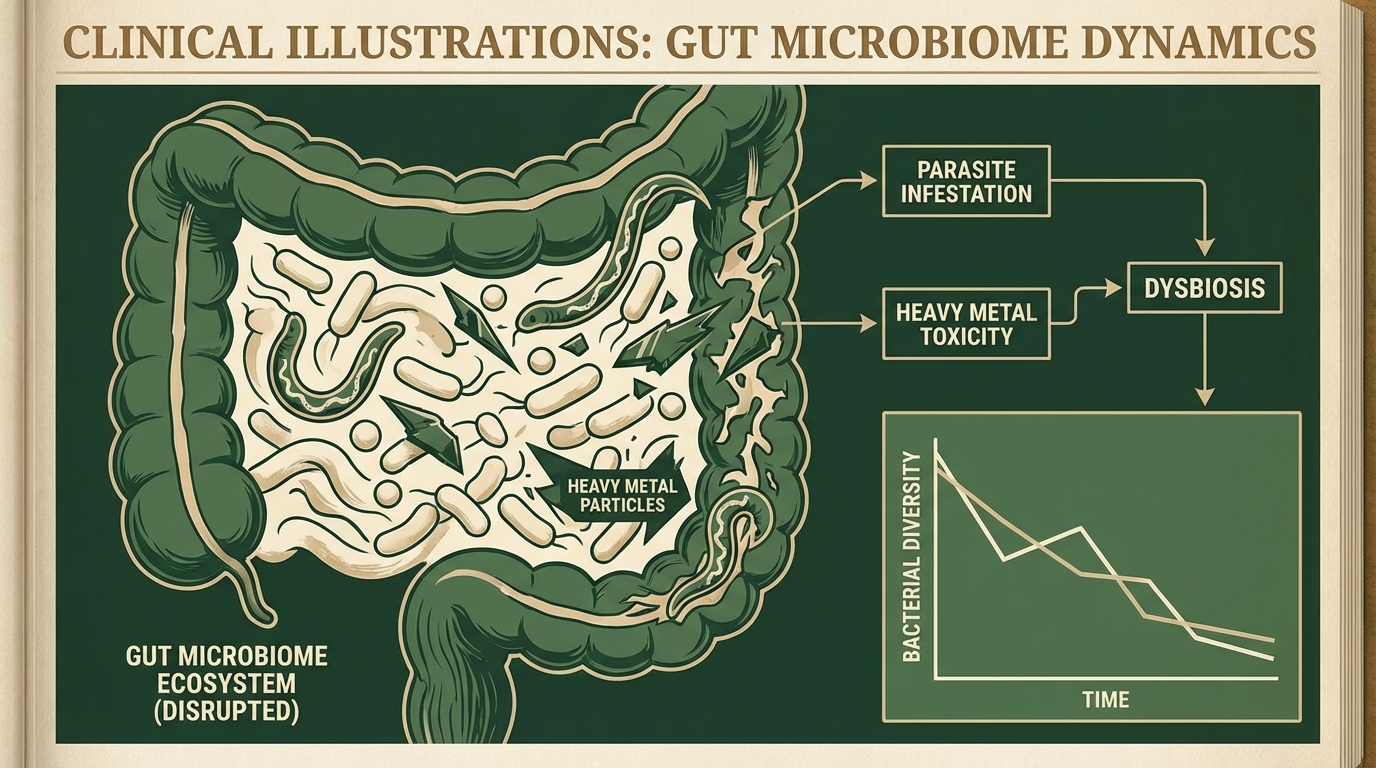
Parasites, heavy metals, and the gut microbiome can interact. That scientifically interesting statement is often stretched into a much larger marketing claim: common symptoms prove a hidden infection or toxic-metal burden, and a cleanse can restore the microbiome.
Human evidence does not support that shortcut.
The short answer: Some parasitic infections and environmental metal exposures are associated with changes in gut microbial communities. Those associations do not allow a microbiome test or symptom quiz to diagnose an infection or poisoning, and they do not prove that a supplement cleanse improves health.
Three different questions are often mixed together
1. Do parasites interact with gut microorganisms?
Yes. Intestinal protozoa and helminths share an environment with bacteria, fungi, viruses, and the host immune system. Infection can be associated with changes in microbial composition and immune response.
2. Can heavy-metal exposure affect the gut microbiome?
Research suggests that arsenic, lead, mercury, cadmium, and other exposures may be associated with microbial changes. Much mechanistic evidence comes from animals or laboratory studies, while human studies are largely observational.
3. Can symptoms or a commercial microbiome test prove parasites or metal toxicity?
No. Diagnosis requires an exposure history and validated testing for the specific concern.
Parasites are not one disease
“Parasite” includes many organisms with different life cycles and effects. Some live primarily in the intestine; others affect blood, liver, lungs, skin, muscles, brain, or other tissues.
The CDC notes that foodborne protozoa often cause diarrhea and gastrointestinal symptoms, while helminth infections can cause a wider range of findings depending on the organism and burden.
Treatment is likewise specific. A universal herbal combination cannot be assumed to work across protozoa, worms, and external parasites.
What human microbiome research shows about helminths
A systematic review and meta-analysis of human datasets reported associations between helminth infection and increased bacterial richness and diversity.
That finding complicates simplistic “parasites always destroy diversity” messaging. Diversity is not a universal score of health, and an infection can be harmful even when one diversity metric increases.
Important limitations include:
- Different helminth species
- Different populations and environments
- Diet, geography, sanitation, medications, and age
- Observational designs
- Inability to prove that a microbial change caused a symptom or outcome
Microbiome association research helps scientists study mechanisms. It is not a home diagnostic tool.
What human research shows about heavy metals
A systematic review of human observational studies identified 12 studies examining arsenic, lead, mercury, or cadmium exposure and gut-microbiota composition.
The review found associations, but results were not homogeneous. Studies differed in:
- Metal and exposure level
- Age and life stage
- Biospecimen used to measure exposure
- Microbiome method
- Geography and diet
- Confounder adjustment
- Study design
Observational association cannot establish that a particular microbial pattern proves exposure or that changing the microbiome removes the metal.
The gut microbiome may influence toxicology—but research is early
Gut microbes can transform compounds and influence absorption, metabolism, and immune signaling. Reviews have discussed possible microbiome effects on arsenic and other metals.
For example, a review of the human gut microbiome and arsenic concluded that clinical and epidemiological evidence connecting microbial changes to arsenic-related health outcomes remained limited, even though the mechanism is scientifically plausible.
“Plausible” and “proven treatment” are different evidence categories.
Why symptoms cannot identify the cause
Bloating, fatigue, abdominal discomfort, diarrhea, constipation, skin symptoms, and concentration problems can occur for many reasons.
These symptoms do not distinguish among:
- A parasitic infection
- Lead, mercury, arsenic, or cadmium exposure
- Irritable bowel syndrome
- Celiac disease
- Constipation
- Medication effects
- Sleep disruption
- Anemia
- Thyroid disease
- Other infections or chronic conditions
Starting with a predetermined cause can lead to the wrong test and treatment.
Testing should follow the hypothesis
For parasites, testing may involve stool microscopy, antigen or molecular tests, blood testing, imaging, or another method selected for the organism. The CDC diagnostic guide emphasizes symptoms, medical conditions, and travel history.
For metals:
- Suspected lead exposure is generally evaluated with a blood lead level.
- Recent arsenic exposure may be evaluated with speciated urine testing.
- Mercury and cadmium testing depend on the form, source, and timing.
- Hair and provoked urine tests have important limitations.
Do not treat a broad commercial panel as interchangeable with metal-specific clinical testing.
What the research does not prove
Existing microbiome studies do not prove that:
- Common symptoms identify parasites or heavy metals
- Everyone accumulates a dangerous “toxic burden”
- A probiotic removes toxic metals
- Cilantro, chlorella, zeolite, wormwood, or black walnut restores a disrupted microbiome
- A short cleanse produces durable microbiome repair
- Stool diversity alone measures overall gut health
Each of those claims needs direct evidence for the intervention, population, outcome, and safety profile.
A safer decision path
- Define the concern. Is there a plausible exposure or infection risk?
- Document the timeline. When did symptoms begin?
- Identify red flags.
- Choose a validated, specific test if indicated.
- Remove or reduce a confirmed exposure source.
- Treat a confirmed infection or toxicity with appropriate care.
- Use diet and lifestyle to support general health without claiming they replace treatment.
For a possible poisoning in the United States, Poison Control is available at 1-800-222-1222 and PoisonHelp.org.
The CleanseCode verdict
Parasites and heavy-metal exposure can interact with the gut microbiome, but the research is nuanced and often observational. It cannot turn a symptom quiz into a diagnosis or a supplement stack into established treatment.
Use the microbiome evidence to ask better questions—not to skip organism-specific or metal-specific evaluation.
Frequently asked questions
Do parasites always reduce gut-microbiome diversity?
No. Human helminth research has reported increased richness and diversity in some settings. The clinical meaning varies and does not make infection beneficial.
Can a stool microbiome test diagnose parasites?
A general microbiome profile is not the same as validated parasite testing. Specific stool antigen, molecular, or microscopic tests may be used depending on the concern.
Can probiotics treat heavy-metal poisoning?
There is not established clinical evidence that consumer probiotics replace exposure removal or medically indicated treatment.
Does “brain fog” indicate heavy metals?
No. Difficulty concentrating is nonspecific and cannot identify a metal exposure.
Medical disclaimer: This article provides general educational information and is not medical advice.
Correction note: This revision removes unsupported causal claims and cleanse recommendations while preserving the legitimate, emerging science of host–parasite–microbiome and metal–microbiome interactions.