
The short answer
There is no single test for “parasites.” What exists is a set of narrow tests, each aimed at a specific organism, and the one you need depends entirely on which organism is plausible. For most people in the United States with persistent gut symptoms, the defensible first step is a stool antigen test for Giardia and Cryptosporidium, ordered by a clinician — the CDC calls stool antigen “the preferred test” for Giardia. A comprehensive stool ova-and-parasite exam adds coverage of other protozoa and worms. Pinworm needs a tape test, not a stool test. Strongyloides needs a blood antibody test, not a stool test.
Three things will not tell you whether you have a parasite: a symptom questionnaire, an eosinophil count on its own, and a direct-to-consumer “comprehensive stool analysis” that reports organisms most laboratories consider harmless.
And the honest part: the reason this article is long is that almost every test has a sensitivity problem, a specificity problem, or an interpretation problem, and the marketing around parasite testing depends on you not knowing which.
Our review of parasite cleanse protocols ended where most articles on the subject end: with the advice to get appropriately tested instead. That advice is worthless without the next paragraph, because “get tested” is exactly what the cleanse industry also says — right before selling you the test. So this is the next paragraph.
The stool test you are offered is not one test
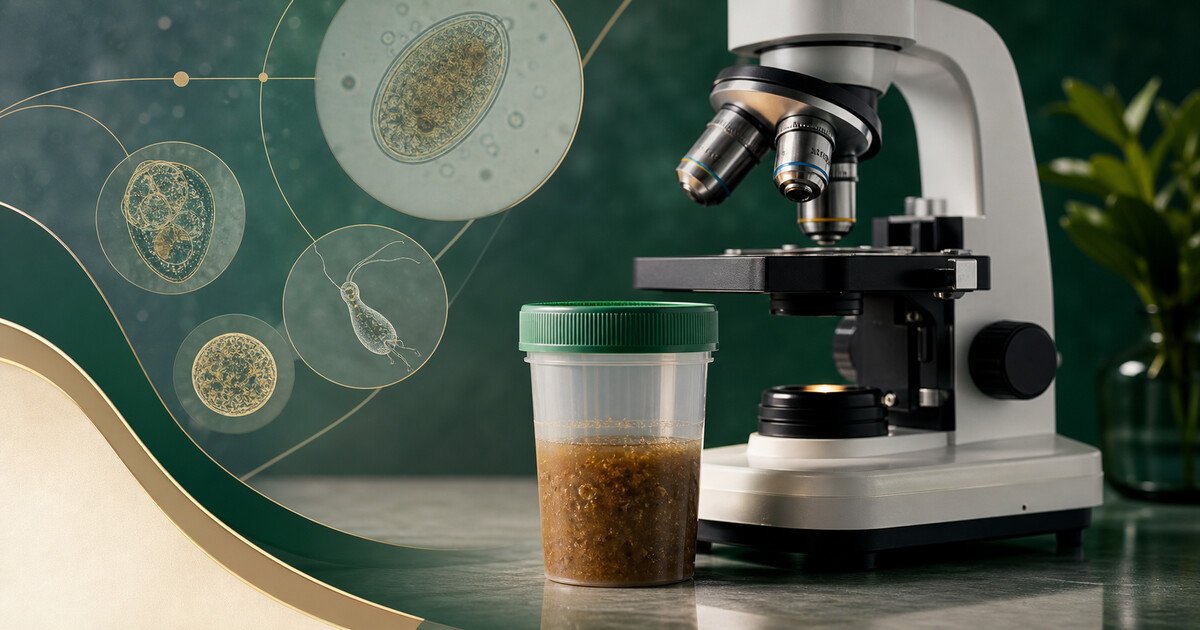
A comprehensive stool ova and parasite examination (usually written O&P) is three separate procedures performed on one specimen: a direct wet mount, which looks for motile trophozoites; a concentration step, typically formalin-ethyl acetate sedimentation, which brings eggs, larvae and cysts into view; and a permanent stained smear, usually trichrome, which is the part that actually identifies protozoa by morphology. The American Society for Microbiology’s consensus laboratory document notes plainly that these methods “are nonautomated and require extensive bench experience for accurate performance and interpretation.”
This matters more than it sounds, because the container your sample goes into determines which of those procedures can be run at all. CDC’s DPDx laboratory guidance is specific: if a two-vial kit is not available, the specimen “should be divided and stored in two different preservatives, 10% formalin and PVA,” at one volume of stool to three volumes of preservative. Formalin preserves helminth eggs, larvae and cysts well, is compatible with immunoassay kits, but gives “inadequate preservation of morphology of protozoan trophozoites” and “can interfere with PCR, especially after extended fixation time.” PVA does the opposite: excellent trophozoite morphology, but it “cannot be used with immunoassay kits” and is unsuitable for concentration. Refrigerated stool with no preservative at all, CDC says, is “suitable for antigen testing only.”
The practical consequence: “I sent in a stool sample” tells you almost nothing about what was actually looked for. A single formalin vial cannot support trichrome-quality protozoan identification or reliable PCR. A PVA vial cannot support an antigen test. Ask which fixatives were used and which of the three procedures were performed.
Several everyday substances also invalidate the test. CDC lists antacids, kaolin, mineral oil and other oily materials, non-absorbable antidiarrhoeal preparations, and gives specific clearance windows: barium or bismuth need 7 to 10 days, antimicrobial agents 2 to 3 weeks, and gallbladder dyes 3 weeks. Bismuth subsalicylate is the active ingredient in Pepto-Bismol. If you have been self-treating a two-week bout of diarrhoea, your sample may not be usable, and no one will necessarily tell you.
How many samples? The rule is contested, and that is worth knowing
CDC’s consumer page states that “CDC recommends that three or more stool samples, collected on separate days, be examined.” Its laboratory guidance is slightly different and more conditional: “Specimen collection may need to be repeated if the first examination is negative. If possible, three specimens passed at intervals of 2-3 days should be examined.”
The reason is intermittent shedding. Protozoan cysts and helminth eggs are not released at a constant rate, and stool consistency changes what is visible — trophozoites in liquid stool, cysts in formed stool. But the size of the effect has been measured, and it is smaller than the folklore suggests.
| Study | Setting | What it found |
|---|---|---|
| Cartwright, J Clin Microbiol 1999 | 2,704 exams, 1,374 patients, high-prevalence setting | The first specimen was adequate in 75.9% of cases; two specimens reached 92%; the third added information on only 8% of occasions. Conclusion: two specimens. |
| Branda et al., Clin Infect Dis 2006 | Massachusetts General Hospital | 91% of parasites were detected in the first specimen submitted. Where three were submitted, examining only the first had 72% sensitivity. Conclusion: “Comprehensive examination of a single stool specimen is sufficient for most patients, when the prevalence of infection among the tested population is up to 20%.” |
| Hiatt et al., Am J Trop Med Hyg 1995 | Symptomatic patients, Kaiser Northern California | Going from one exam to three increased yield by 22.7% for E. histolytica, 11.3% for Giardia, and 31.1% for Dientamoeba fragilis. Thirteen patients with E. histolytica needed four to nine examinations. |
So a single comprehensive O&P recovers roughly 72 to 76 percent of what three would find; two specimens reach about 92 percent; the third adds around 8 percent. Those are the numbers to hold onto, and they are considerably better than the “stool tests miss half of all parasites” claim that circulates in cleanse marketing. The laboratory literature genuinely disagrees with CDC about whether three specimens are necessary in a low-prevalence population, which is a real scientific disagreement rather than a reason to distrust testing altogether.
The bigger gap is coverage, not repetition. The 2017 IDSA infectious diarrhoea guideline states it directly: “Because microscopic examination of stool for ova and parasites is unlikely to include testing for Cryptosporidium and Cyclospora, clinicians should specifically request Cryptosporidium and/or Cyclospora testing.”
The mechanism is mundane. Trichrome, the standard permanent stain, leaves Cryptosporidium oocysts unstained — CDC’s own page says “trichrome staining is inadequate for a definite diagnosis.” Cryptosporidium, Cyclospora and Cystoisospora need a modified acid-fast stain; microsporidia need a modified trichrome. IDSA’s table footnote adds: “These stains may not be routinely available.”
Antigen tests: the best-performing option, and the worst, share a name
Antigen tests detect organism-specific proteins rather than looking for the organism itself. For the two most common intestinal protozoa in the US, they have largely displaced microscopy. CDC’s laboratory figures for direct fluorescent antibody (DFA) testing are 99% sensitivity and 100% specificity for Cryptosporidium, and 100% for both measures for Giardia. CDC’s domestic guidance for immigrant and refugee health is blunt about the comparison: “Stool ova and parasite testing has low sensitivity. Stool antigen is the preferred test for identifying Giardia infections.”
But “antigen test” covers two very different technologies, and the independent evaluations are much less flattering than the headline figures. Johnston and colleagues, testing 246 specimens against DFA as reference, found the ImmunoCard STAT rapid strip detected 81% of Giardia and only 68% of Cryptosporidium. Weitzel and colleagues, across 220 samples, found rapid strips ranging from 44% to 88% sensitivity, and concluded that these assays “were less sensitive than conventional microscopical methods” and “might be a useful addition to, but not a substitute for” microscopy. Specificity in both studies was excellent, at 98% or above.
In other words: laboratory immunofluorescence genuinely outperforms a microscope. A lateral-flow strip does not. If you are told you had “an antigen test,” which one is a fair question.
The other limitation is scope. Antigen tests are organism-specific by design. A negative Giardia and Cryptosporidium panel — which is what most US laboratories now run as their front-line parasitology test, per IDSA’s note that the two “are often offered and performed together as the primary parasitology examination” — says nothing whatsoever about Entamoeba, Cyclospora, Strongyloides, or any worm.
Multiplex PCR panels: more sensitive, harder to interpret
Syndromic molecular panels test one specimen for a fixed list of pathogens at once. In the multicentre evaluation of the BioFire FilmArray gastrointestinal panel across 1,556 prospective specimens, the parasite targets performed extremely well: 100% sensitivity for Cryptosporidium, Cyclospora cayetanensis and Giardia lamblia, with specificity above 99% for each.
The complications are real, and IDSA wrote two of them into formal recommendations. Recommendation 14: “Clinical consideration should be included in the interpretation of results of multiple-pathogen nucleic acid amplification tests because these assays detect DNA and not necessarily viable organisms.” A positive result can mean an active infection, a resolved infection still shedding nucleic acid, or asymptomatic carriage.
Co-detection is the second problem. In the BioFire evaluation, multiple pathogens were found in 31.5% of positive specimens, up to six in one sample, and the authors acknowledged that “the clinical implications of specific pathogen combinations are not well documented or understood.” A review in the same journal was more direct: “insufficient data are available to guide laboratorians and clinicians on how to interpret these findings.”
Two further points rarely make it into consumer coverage. First, these panels are worse than microscopy for worms: in a 2024 Belgian travel-clinic comparison, multiplex PCR detected 59.1% of helminth infections against 100% for the conventional workflow. Second, switching methods inflates apparent prevalence dramatically. A 2025 analysis of 3,495 stools found Blastocystis in 19.25% by qPCR versus 6.55% by microscopy, and Dientamoeba fragilis in 8.86% versus 0.63% — roughly three-fold and fourteen-fold increases with no change in the underlying population. CDC has said the same about its own surveillance data, attributing part of a 47.2% decade-long rise in cryptosporidiosis incidence to “increasing use of diagnostic multiplex PCR panels.”
Reagent cost runs roughly 80 to 155 US dollars per specimen, and the published recommendation is to reserve highly multiplexed panels for immunocompromised patients, the critically ill, or people with prolonged diarrhoea, rather than using them as a first-line screen.
Which test for which parasite
| Organism | Right test | What to know |
|---|---|---|
| Giardia duodenalis | Stool antigen (DFA or EIA); NAAT | CDC calls antigen “the preferred test.” Most infections are asymptomatic, and CDC states it is unknown whether treating asymptomatic infection benefits the host. |
| Cryptosporidium | DFA (reference standard); EIA; NAAT; modified acid-fast stain | Not covered by a routine trichrome O&P — must be requested by name. Multiple specimens advised before calling it negative. |
| Entamoeba histolytica | Species-specific immunoassay or NAAT | Microscopy cannot distinguish E. histolytica from the harmless E. dispar and E. moshkovskii, which is why labs report the combined name. Only one of the three needs treating. |
| Cyclospora, Cystoisospora | Modified acid-fast stain; NAAT | Request specifically. Associated with fresh produce, leafy greens and berries. |
| Pinworm (Enterobius vermicularis) | Perianal tape test, three consecutive mornings | Stool testing is the wrong test — see below. |
| Strongyloides stercoralis | IgG serology (blood) | Stool misses most cases. Screening is mandatory before corticosteroids or immunosuppression in at-risk people. |
| Soil-transmitted helminths (Ascaris, hookworm, whipworm) | Stool microscopy with concentration | Microscopy beats PCR here. Rare in the continental US outside specific exposures. |
| Blastocystis, Dientamoeba fragilis | Arguably none — see below | Pathogenicity is formally described as controversial by IDSA, CDC and three national laboratory bodies. |
Pinworm: the test almost everyone gets wrong
Pinworm is the one intestinal worm that is genuinely common in high-income countries, and it is the one where a stool test is close to useless. The gravid female migrates out through the anus at night to lay eggs on the perianal skin, so the eggs largely bypass the faecal stream entirely. CDC’s Yellow Book puts it in one sentence: “Examining stool samples is not recommended because pinworm eggs are sparse.”
Published estimates for how often pinworm eggs turn up on a stool exam cluster around 5 percent, with Public Health Ontario giving “under 10%.” CDC publishes no figure of its own.
The correct test costs nothing. Press the sticky side of clear tape against the skin beside the anus first thing in the morning, before washing, using the toilet, or getting dressed, and repeat on three consecutive mornings. Public Health Ontario reports sensitivity below 60% for a single specimen, rising to about 90% with three collected daily, and close to 100% with six, and advises collecting for four to six consecutive days to rule infection out. Adult worms are sometimes visible around the anus two to three hours after the person falls asleep.
A correction we owe readers: the sensitivity figures of 50%, 90% and 99% for one, three and five tape tests are quoted widely, including in clinical references. We could not trace them to a primary study — the citation trail ends at an unnamed “one report.” Only the roughly 90-percent-at-three-tests figure is corroborated by two independent sources. We have used those instead.
Strongyloides: the one where a normal stool test is actively misleading
Strongyloides stercoralis deserves its own section because the stakes are asymmetric. Infection is usually silent for years, and CDC notes that “traditional stool examinations are insensitive and can require up to seven exams to reach a sensitivity of 100%.” A single stool exam misses up to 70% of cases. The best primary data on cumulative yield, from 864 specimens, found 32.4% detection with one specimen, 49.1% with two, 59.3% with three and 66.7% with four.
Worse, the standard concentration step can destroy the evidence: CDC warns that “formalin-ethyl acetate concentration may remove larvae and reduce sensitivity.” A routine O&P sent to a general laboratory can be counterproductive for this organism specifically. The sensitive stool methods — Baermann funnel sedimentation, Koga agar plate culture — are not offered by most US general laboratories.
The right test is a blood antibody test. CDC’s own antigen EIA has 96% sensitivity and 98% specificity, though cross-reactions with filariasis, schistosomiasis and ascariasis occur: in one systematic review, 77% of people with known hookworm infection tested positive for Strongyloides. A negative serology does not fully exclude infection, as a 2026 report of two transplant recipients infected by a donor with a negative ELISA demonstrated.
This is the one piece of parasite testing that is genuinely urgent for some people. In someone with untreated strongyloidiasis, corticosteroids can convert a silent infection into hyperinfection or disseminated disease. Published case-series mortality estimates range from roughly 45% to 90% — a wide range, because these syntheses are built from case reports that skew heavily toward fatal outcomes.
CDC’s Yellow Book recommendation is explicit: “Perform serologic testing for patients at risk for Strongyloides infection who will be placed on corticosteroids or other immunosuppressive drug regimens, or who will undergo procedures that involve immunosuppression,” and treat before starting. If you have lived in or travelled extensively through a tropical or subtropical region and are about to start prednisone, a biologic, or a transplant workup, this is the test to raise with your clinician.
The two organisms your stool panel probably found, and probably should not have
This is the section that matters most, because it explains most positive results on consumer stool tests.
Blastocystis and Dientamoeba fragilis are the two organisms most likely to appear on a direct-to-consumer stool report, and the evidence that either causes disease is weak enough that several national bodies have stopped looking for them. IDSA’s guideline carries the position in a footnote: “The pathogenicity of Blastocystis hominis and Dientamoeba fragilis remains controversial. In the absence of other pathogens, they may be clinically relevant if symptoms persist.” Neither organism has an IDSA testing or treatment recommendation anywhere in the document. CDC’s clinical page for D. fragilis is plainer still: infections “are often asymptomatic and require no treatment.”
Three lines of evidence explain that caution.
Carriage in healthy people is extraordinarily common. A survey of 2,154 metagenomes found Blastocystis in 14.9% overall and 22.4% in Europe; a later analysis of 56,989 metagenomes across 32 countries found prevalence ranging from 2.46% in Japan to 56.29% in Fiji. In more than 22,000 routine Danish stool samples, D. fragilis was positive in 43%. In a study following 142 Danish day-care children, 68.3% were positive at the first sampling, every one of the 108 children followed was eventually positive, and there was “no statistical association between a recent history of gastrointestinal symptoms and testing positive.”
The two largest population-based case-control studies found both organisms more common in healthy people. A Danish study of 124 people with IBS against 204 controls found that “a greater proportion of controls than cases carried the parasites (50% vs 36%).” A Dutch multicentre study of 1,374 gastroenteritis cases against 1,026 controls found Blastocystis in 25.8% of cases versus 40.0% of controls, and D. fragilis in 25.8% versus 37.6%, concluding that the presence of these organisms “may be considered characteristic of a healthy intestinal microbiome.” A 2024 analysis of nearly 57,000 people went further, associating Blastocystis with more favourable cardiometabolic profiles and inversely with obesity, and finding that improvements in diet quality were followed by increases in Blastocystis prevalence.
And the treatment trials are null. Two double-blind, placebo-controlled randomised trials have tested metronidazole in people carrying these organisms. In 96 children with chronic gastrointestinal symptoms and D. fragilis, symptom improvement was essentially identical between drug and placebo. In 50 adults with Blastocystis, resolution was 47.2% on metronidazole versus 51.4% on placebo. The dissociation is the finding: the drugs clear the organism, and the symptoms do not change.
The Royal College of Pathologists of Australasia states the practical risk in one sentence: “Symptoms are often falsely attributed to the presence of these organisms leading to overtreatment.” Its guidance recommends choosing a multiplex PCR panel without these two targets. Public Health Ontario has stopped reporting Blastocystis altogether, citing “its lack of documented pathogenicity and increasing recognition of its role as a positive biomarker of healthy outcomes.” Blastocystis and D. fragilis are also deliberately absent from the FDA-cleared BioFire gastrointestinal panel.
In fairness, the case is not closed. A 2017 meta-analysis of 17 studies found a pooled association between Blastocystis and IBS with an odds ratio of 2.19, though the same analysis found no association at all for D. fragilis. That evidence is dominated by hospital-based case-control studies in high-prevalence settings, which are vulnerable to reverse causation, and it is contradicted by every large population-based dataset. A 2026 paper also argues that at least one widely used PCR assay for D. fragilis produces false positives in human samples, which would undermine some of the high-carriage findings — but that argument cuts both ways, since the same assays generate the positive results being used to sell treatment.
One US-specific number is worth keeping in mind before applying European prevalence figures to yourself: across 4,804 gastrointestinal parasite PCR tests run in Utah between 2014 and 2024, D. fragilis positivity was 0.6%.
Blood tests, and why “high eosinophils” is not a parasite result
CDC states the position without qualification: “Blood tests look for a specific parasite infection; there is no blood test that will look for all parasitic infections.” Serology is genuinely useful for Strongyloides, for invasive amebiasis, and for tissue-dwelling helminths such as schistosomes — but IDSA recommends against serology for establishing the cause of infectious diarrhoea generally.
Eosinophil count deserves specific attention because it is the number most often presented as evidence of a parasite. Peripheral eosinophilia is defined as 500 or more eosinophils per microlitre. IDSA’s guideline notes that “an increased eosinophil count may occur with parasitic infections that involve a tissue phase” — and that clause is the whole problem, because the intestinal protozoa people actually worry about do not have one. CDC’s Yellow Book explicitly lists Entamoeba histolytica, Cryptosporidium, Cyclospora cayetanensis and Giardia as parasitic infections without peripheral eosinophilia.
The best quantitative test of eosinophilia as a screening tool examined 2,004 US-bound refugees in Thailand against a qPCR reference standard, in a population where roughly 73% were infected with at least one parasite. Sensitivity ranged from 51% to 73%, and specificity from 48% to 65% — barely better than chance on the specificity side. The authors’ conclusion was that “the predictive value of eosinophilia is poor for the most common parasitic infections, and it should not be used alone for screening.” In a low-prevalence US population, positive predictive value falls further still. Atopy, asthma, drug reactions and several non-infectious conditions are far more common explanations for a mildly raised eosinophil count in the United States than worms are.
Who should actually be tested
The clearest threshold in the guidelines is for travellers. IDSA Recommendation 13: “Diagnostic testing is not recommended in most cases of uncomplicated traveler’s diarrhea unless treatment is indicated. Travelers with diarrhea lasting 14 days or longer should be evaluated for intestinal parasitic infections.”
Beyond that, testing is indicated for people with moderate or severe immune deficiency and diarrhoea, where IDSA calls for a broad differential including Cryptosporidium, Cyclospora, Cystoisospora and microsporidia; and for specific exposures, which the guideline tabulates. Swimming in or drinking untreated fresh water, and inadequately chlorinated pools, point to Cryptosporidium and Giardia. Child-care attendance or employment, and healthcare, long-term care or prison settings, point to the same two. Travel to resource-limited countries widens the list to Entamoeba histolytica, Cyclospora and Cystoisospora. Farm and petting-zoo visits point to Cryptosporidium. Anal-genital, oral-anal or digital-anal contact points to E. histolytica, Giardia and Cryptosporidium alongside bacterial and sexually transmitted infections.
What no authority recommends is testing asymptomatic people in the general population. IDSA advises against follow-up testing after diarrhoea has resolved in most cases, and against empiric treatment of asymptomatic contacts. Choosing Wisely Australia’s infectious-diseases recommendation is a single line: “Do not investigate or treat for faecal pathogens in the absence of diarrhoea or other gastro-intestinal symptoms.” The American College of Gastroenterology recommends against routine stool testing for enteric pathogens in irritable bowel syndrome, while endorsing targeted Giardia testing in people at high risk — a sensible exception, given that the relative risk of developing IBS after a documented Giardia infection is around 3.4.
Tests to avoid, and one sentence that explains why
Direct-to-consumer “comprehensive stool analysis” panels — the category that includes GI-MAP, GI Effects and similar products — are laboratory-developed tests. They run under CLIA certification rather than FDA clearance, and the vendors’ own reports say so: one states that its assays “have not been cleared by the U.S. Food and Drug Administration.” Following a federal court decision in March 2025 and a subsequent FDA rule reverting the regulation, FDA does not currently exercise premarket review over laboratory-developed tests. FDA-cleared stool parasite testing does exist, for contrast — the BioFire gastrointestinal panel holds 510(k) clearance K230404.
The sentence that matters most comes from CMS, which administers CLIA: “CMS’ CLIA program does not address the clinical validity of any test,” and the routine survey “does not include a review of the clinical validation of a LDT — that is, the accuracy with which the test identifies, measures, or predicts the presence or absence of a clinical condition.” So “CLIA-certified laboratory” is a real statement about laboratory process, and not a statement that the result means what the report says it means.
Two specific features of these reports are worth naming. One panel reports seven organisms in its parasitology section, four of which are textbook non-pathogenic commensals, and prints numeric “reference ranges” for Blastocystis and D. fragilis — implying a validated pathogenic threshold that does not exist in the peer-reviewed literature. The same panel is not available for ordering in New York State, which independently reviews laboratory-developed tests. We could find no peer-reviewed validation study of any of these panels for parasite detection, which is an absence of evidence rather than a demonstration of inaccuracy, and worth stating as exactly that.
The closest thing to independent evidence on this category is a 2026 study from the National Institute of Standards and Technology, which sent identical stool material in triplicate to seven direct-to-consumer services. It found “major discrepancies, both within and across the different service providers,” with between-provider variability on the same scale as biological variability between different donors — three companies detecting C. difficile in material where four reported it absent, and one company grading replicates of a single sample as both healthy and unhealthy. Two honest caveats: that study tested microbiome profiling rather than parasite panels, and it is a single study.
The methods with no diagnostic role at all are easier to summarise. Live blood analysis, iridology, applied kinesiology or muscle testing, and electrodermal, bioresonance or “zapper” devices have no validated ability to detect parasites; iridology in particular has been tested in blinded controlled studies and a systematic review, all negative.
As for symptom quizzes, the honest position is narrower than a debunking. The two published studies of symptom-based screening, both from high-prevalence settings, found that no single symptom performed adequately — for example, abdominal pain at 54% sensitivity, and anal itching at 29.8%. But the symptoms those studies examined were abdominal pain, diarrhoea, loss of appetite, nausea and perianal itching. For the items that dominate consumer quizzes — sugar cravings, fatigue, bloating, teeth grinding — we found no published diagnostic-accuracy assessment at all. They have never been evaluated as diagnostic indicators, which is different from having been refuted, and it means nobody selling a quiz based on them can know that it works.
One quoted claim worth carrying with you. In a 2020 warning letter, the FDA quoted a parasite-cleanse seller’s own marketing: “70% of parasites are microscopic and not everyone will see visible parasites during the cleanse.” That is the rhetorical structure that makes a negative result impossible — if you see something it worked, and if you see nothing it also worked. It was the firm’s second warning letter in three years.
How common are intestinal parasites in the US, honestly?
There has never been a nationally representative US stool-parasitology survey, so any confident percentage should be treated with suspicion — including the widely repeated claim that a fifth of Americans harbour parasites, which does not trace to a US population study. The verifiable picture is that giardiasis and cryptosporidiosis are nationally notifiable and tracked in the thousands to low tens of thousands of cases a year; that the CDC no longer publishes the “40 million” pinworm figure that circulates online, and has removed the page it came from; that a 2017 finding of 34.5% hookworm prevalence in rural Alabama did not replicate, with a later 704-stool study in the same county finding none; and that Toxocara seroprevalence has been revised down from 14% to about 5%, and is not an intestinal infection in humans anyway.
None of this means parasitic infection does not happen in the United States. It means the base rate for an average person with bloating is low, which is precisely why the pre-test question — what specific exposure or symptom pattern makes this plausible? — matters more than the test itself.
Six questions worth asking your clinician
- Which specific organisms is this test able to detect, and which does it not cover?
- Does it include Cryptosporidium and Cyclospora, or do those need to be requested separately?
- If this is an antigen test, is it laboratory immunofluorescence or a rapid strip?
- Given my exposures and how long this has lasted, what is the realistic likelihood of finding something — and what changes if it comes back negative?
- If Blastocystis or Dientamoeba fragilis is reported, what will we do with that result?
- Have I taken bismuth, antacids, antibiotics or barium recently, and does that invalidate the sample?
Frequently asked questions
Can I just order a stool test online instead of seeing a doctor?
You can, and for standard laboratory panels ordered through a direct-access CLIA laboratory the underlying test may be identical to what a physician would order. The difficulty is not the sample — it is that interpretation carries most of the value. A result showing a non-pathogenic commensal with a printed “reference range” is more likely to lead you toward unnecessary treatment than toward an answer. If you order a test yourself, take the report to a clinician before acting on it.
My stool test was negative but I still have symptoms. Does that mean the test missed something?
Sometimes, and the numbers above give you the honest odds: a single comprehensive exam finds roughly three-quarters of what three would, and specific organisms such as Strongyloides and pinworm need entirely different tests. But a negative result in a low-prevalence population is much more often correct than not. Persistent symptoms with negative parasitology are a reason to widen the differential — coeliac disease, inflammatory bowel disease, bile acid diarrhoea, lactose or fructose malabsorption, post-infectious IBS — rather than to test the same way repeatedly.
Is a PCR panel better than a standard stool exam?
For the protozoa on its target list, yes, and substantially so. For worms, no — microscopy outperforms it clearly. And a positive PCR result detects DNA rather than a living organism, which is why interpretation needs clinical context. Cost also makes it a poor first-line screen for someone with mild, long-standing symptoms.
Should I test my whole family if one of us is positive?
For pinworm, household treatment is a normal part of management because reinfection is so easy. For Blastocystis and D. fragilis, the Australasian pathology guidance is explicit that “screening for clearance of the organism or testing of family members is not recommended.” For everything else, ask your clinician — it depends on the organism and on whether anyone else has symptoms.
Do I need to be tested if I have no symptoms?
In the general US population, no authority recommends it. The single narrow exception in CDC guidance is screening newly arrived refugee children under five for Giardia antigen. There is a separate, important exception that is not screening but risk management: Strongyloides serology before starting corticosteroids or immunosuppression, if you have relevant exposure history.
What about the things people photograph after a cleanse?
No peer-reviewed laboratory analysis of a “rope worm” specimen exists in either direction, so anyone who tells you definitively what those objects are is going beyond the evidence — us included. What is documented is that psyllium forms a hydrogel and that colonic bezoars can form, which offers a plausible mechanism. If you want something identified, a laboratory can look at it; a photograph on a forum cannot.
When to seek care promptly. Bloody diarrhoea, fever, signs of dehydration, unintentional weight loss, or diarrhoea lasting more than a week all warrant medical attention rather than a test ordered online.
On sources. Every figure above is drawn from CDC laboratory and clinical guidance, the 2017 IDSA infectious diarrhoea guideline, peer-reviewed primary studies, or the named national bodies. Where a widely repeated figure could not be traced to a primary source, we have said so rather than reproducing it. Where evidence points in two directions, we have given both. If you find an error, tell us and we will publish a correction.